
Commercial truck tires work harder than the tires on an average passenger vehicle. They carry heavy loads, travel long highway distances, encounter changing temperatures, and deal with potholes, road debris, frequent braking, and demanding delivery schedules.
That makes tire inspection more than routine maintenance. It is an important part of keeping a truck safe, compliant, and on the road.
So, how often should commercial truck tires be inspected?
Drivers should check tire condition before operating the truck as part of the pre-trip inspection. Fleets should also perform more detailed tire checks—including inflation pressure, tread depth, wear patterns, and overall condition—on a regular preventive-maintenance schedule.
There isn’t one universal “every 30 days” rule that works for every commercial truck. A high-mileage tractor running interstate routes has very different tire demands from a local box truck making short deliveries.
The best approach combines pre-trip checks, regular measured inspections, scheduled preventive maintenance, and immediate inspections whenever something unusual happens.
Commercial Truck Tire Inspection Schedule at a Glance
Here is a practical way to think about tire inspection frequency:
| When to Inspect | What to Check |
| Before operating the truck | Visible damage, low tires, cuts, bulges, tread and wheel condition |
| During trips and stops | Pressure loss, unusual heat, vibration, visible damage |
| Regular fleet inspection | Tire pressure, tread depth, valves, wear patterns and dual tires |
| Scheduled preventive maintenance | Tires, wheels, alignment, suspension and wheel-end condition |
| After hitting a pothole or curb | Tire, sidewall, wheel and possible alignment damage |
| After unexplained pressure loss | Leak source, puncture, valve and tire condition |
| When uneven wear appears | Inflation, alignment, suspension and mechanical condition |
| After a tire failure | Adjacent tires, wheel, brakes and surrounding components |
The important distinction is that a driver’s daily inspection and a technician’s detailed tire inspection are not the same thing. Both play an important role.
Should Commercial Truck Tires Be Inspected Every Day?
For trucks operating under FMCSA requirements, drivers should be satisfied that important vehicle components—including tires—are in good working order before driving.
That makes checking the tires an important part of a commercial vehicle’s pre-trip routine.
A driver should look for obvious problems such as:
- A flat or visibly low tire
- Cuts or deep abrasions
- Sidewall bulges
- Cracking
- Tread or sidewall separation
- Exposed cords or belt material
- Objects embedded in the tread
- Uneven or unusual wear
- Damaged valve stems
- Wheel or rim damage
- Problems involving dual tires
You don’t need to dismantle anything during every pre-trip check. The objective is to catch visible conditions that could make the truck unsafe or signal that a closer inspection is needed.
A tire that looked normal several days ago should not automatically be assumed to be safe today.
How Often Should Commercial Truck Tire Pressure Be Checked?
Pressure deserves more attention than a quick visual inspection.
A commercial tire can lose pressure without looking obviously flat. For that reason, fleets should include gauge-based pressure checks in their regular tire-maintenance routine.
How frequently those measurements are needed depends on factors such as:
- Daily mileage
- Load
- Tire application
- Road conditions
- Operating temperature
- Fleet maintenance practices
- History of pressure loss
High-mileage trucks and vehicles working in demanding environments may justify more frequent checks.
Whenever possible, tire pressure should be evaluated when the tires are cold and compared with the appropriate inflation requirement for the tire and load.
Why Is Correct Tire Pressure So Important?
The air inside a commercial tire supports the load.
When pressure becomes too low, the tire can flex more than intended while rolling. Excessive flex generates heat and may accelerate irregular wear and casing damage.
Overinflation isn’t the answer either.
Commercial tires should be maintained at the appropriate pressure for their application and load rather than simply inflated to an arbitrary number.
Pressure management is therefore one of the most valuable parts of a commercial truck tire inspection program.
How Often Should Truck Tire Tread Depth Be Checked?
Drivers should look at tread condition during their regular inspections, but fleets should also measure tread depth periodically.
Visual judgment alone isn’t accurate enough when a tire begins approaching its minimum tread depth.
For commercial vehicles subject to federal requirements, 49 CFR §393.75 generally requires:
- Front tires: At least 4/32 inch tread depth in a major tread groove.
- Other tire positions: At least 2/32 inch tread depth in a major tread groove.
These numbers should be treated as regulatory minimums rather than targets for preventive maintenance.
Waiting until every tire reaches its absolute minimum can leave little room for unexpected wear or damage.
A better fleet strategy is to monitor tread depth over time so replacement can be planned before a tire creates an operational problem.
What Should Be Included in a Commercial Tire Inspection?
Tread depth is important, but it tells only part of the story.
A tire can have plenty of tread remaining and still require immediate attention.
1. Tire Pressure
Check for underinflation, unexplained pressure loss, damaged valves, and obvious differences between tires at similar positions.
Repeated pressure loss should be investigated rather than continually corrected by adding air.
2. Tread Condition
Look beyond tread depth.
Check for:
- Cuts
- Embedded objects
- Missing tread
- Cracking
- Separation
- Unusual wear patterns
A nail or piece of metal embedded in the tread may not cause immediate pressure loss but still deserves attention.
3. Sidewall Condition
Sidewall damage can be particularly serious.
Look for cuts, bulges, abrasions, cracking, exposed material, and evidence of impact damage.
Where practical, inspect the inner sidewall too. Damage isn’t always conveniently located where a driver can see it during a quick walk-around.
4. Uneven Tire Wear
Uneven wear shouldn’t automatically be blamed on the tire.
It can indicate another vehicle problem.
Possible causes include:
- Incorrect inflation
- Wheel alignment problems
- Worn suspension components
- Wheel-end problems
- Loading conditions
- Tire mismatch
If one tire repeatedly develops the same unusual wear pattern, simply installing another tire may not solve the problem.
5. Dual Tire Assemblies
Dual tires deserve special attention because the inside tire can easily be overlooked.
Check both tires for condition and obvious inflation problems. Also inspect for debris trapped between the tires and conditions that could cause the pair to operate improperly.
If one tire in a dual assembly loses pressure, the other tire can be forced to carry additional load.
6. Wheels and Rims
The inspection shouldn’t stop at the rubber.
Look for visible wheel damage, cracks, bends, missing or loose components, and anything else that appears abnormal.
A recurring “tire problem” may sometimes originate elsewhere around the wheel position.
When Should Commercial Truck Tires Be Inspected More Frequently?
A standard inspection routine works as a baseline, but some commercial vehicles require closer attention.
High-Mileage Highway Trucks
A tractor traveling hundreds of miles each day accumulates wear quickly.
More miles also mean more exposure to road debris, heat, potholes, and other hazards.
Local Delivery Trucks
Lower mileage doesn’t necessarily mean lower tire stress.
Delivery vehicles may experience frequent turns, braking, curb contact, and stop-and-go driving.
Heavy-Haul Vehicles
Heavier loads make correct tire selection, inflation, and load distribution especially important.
Construction and Work-Site Trucks
Debris, rough roads, gravel, sharp materials, and uneven surfaces increase the possibility of punctures and impact damage.
Vehicles With Repeated Tire Problems
If a truck continually experiences pressure loss, unusual wear, or premature tire failures, increasing inspection frequency makes sense while the underlying problem is investigated.
Repeated failures should be treated as evidence—not bad luck.
What Commercial Tire Problems Require Immediate Attention?
Not every problem should wait until the next scheduled maintenance appointment.
Inspect the tire immediately after:
- A significant pothole impact
- Hitting a curb
- Driving over substantial road debris
- Rapid or unexplained pressure loss
- Discovering a puncture
- Unusual vibration
- Changes in handling
- Abnormal tire wear
- Finding a bulge or separation
- A nearby tire failure
- Unusual heat at one wheel position
Federal regulations also prohibit operating commercial vehicles on tires with certain serious defects, including exposed body ply or belt material, tread or sidewall separation, flats or audible leaks, and cuts that expose ply or belt material.
In other words, good tread depth doesn’t automatically mean a tire is safe.
Can TPMS Replace Manual Commercial Tire Inspections?
No.
A tire pressure monitoring system can be extremely useful for commercial fleets because it can identify pressure changes before a driver might otherwise notice them.
But TPMS primarily monitors pressure-related information.
It cannot replace a physical inspection for issues such as:
- Sidewall cuts
- Bulges
- Tread separation
- Embedded debris
- Uneven wear
- Wheel damage
- Certain alignment-related problems
The best approach is to use tire-monitoring technology as another layer of protection—not as a substitute for drivers and technicians inspecting the tires.
Why Uneven Tire Wear Deserves Attention
One of the biggest opportunities to reduce commercial tire costs is identifying why a tire is wearing abnormally.
Imagine replacing a tire because one shoulder has worn much faster than the rest of the tread.
If the actual cause is an alignment or suspension problem, the replacement tire may develop exactly the same wear.
The fleet has then purchased another tire without correcting the original issue.
Instead, ask:
What does this wear pattern tell us?
A technician may need to investigate inflation, alignment, suspension, wheel-end condition, loading, or another mechanical factor.
This turns tire inspection from a simple pass/fail exercise into preventive maintenance.
How Tire Inspections Can Reduce Fleet Downtime
A commercial truck sitting on the shoulder isn’t generating revenue.
Roadside tire failures can also create:
- Missed delivery windows
- Driver delays
- Emergency service expenses
- Towing costs in some situations
- Secondary vehicle damage
- Customer dissatisfaction
- Rescheduling problems
Regular inspections can’t eliminate every unexpected tire failure, but they can help catch many developing problems before they become roadside emergencies.
Consider the difference between discovering a slow leak in the fleet yard and discovering it after the tire fails 150 miles into a route.
The first is scheduled maintenance.
The second is unplanned downtime.
That difference matters when a fleet operates multiple trucks every day.
Create a Simple Commercial Tire Inspection Routine
An effective inspection program doesn’t need to become unnecessarily complicated.
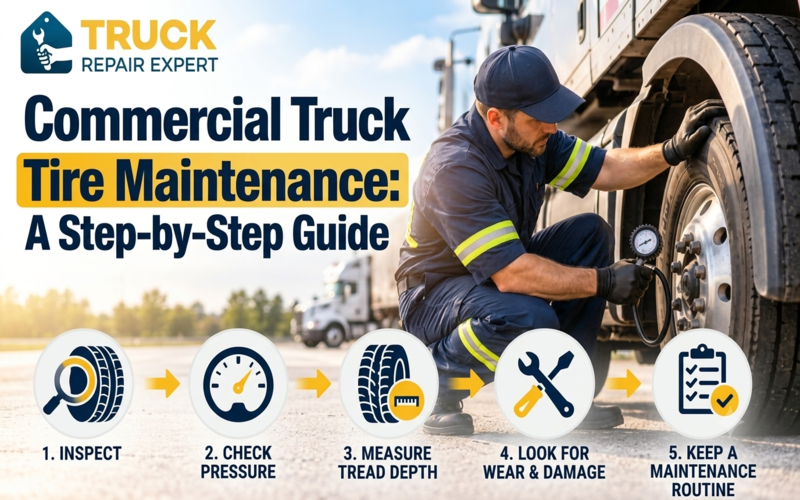
A practical routine can follow four stages.
Before operation:
Drivers visually inspect tires, wheels, and obvious problem areas.
During operation:
Pay attention to warning systems, vibration, handling changes, unusual heat, or visible damage discovered during stops.
Regular maintenance checks:
Measure pressure and tread depth and inspect valves, wear patterns, dual assemblies, and overall tire condition.
Scheduled preventive maintenance:
Evaluate tires alongside alignment, suspension, brakes, and wheel-end components when appropriate.
Keeping records makes this even more useful.
Tracking tire position, tread measurements, pressure history, repairs, and replacements can help fleet managers spot patterns that are difficult to notice from one inspection alone.
When Should You Call a Commercial Tire Professional?
Drivers and fleet managers shouldn’t have to guess whether a damaged tire can safely remain in service.
Professional inspection is particularly valuable when a tire:
- Keeps losing pressure
- Has a puncture
- Shows sidewall damage
- Develops a bulge
- Has irregular wear
- Has suffered a significant impact
- Is separating
- Has already failed
- Needs roadside replacement
When a truck cannot safely continue its trip, mobile service can also eliminate the need to drive a damaged tire to a repair facility.
Truck Repair Expert provides 24/7 mobile commercial tire repair for semi-trucks, trailers, box trucks, and other commercial vehicles. For roadside tire problems, technicians can come to the vehicle, inspect the issue, and perform appropriate tire repair or replacement when conditions allow.
That makes professional mobile tire service particularly valuable when a problem is discovered away from the fleet yard or repair shop.
How Often Is Often Enough?
There is no single inspection interval that replaces good tire-management practices.
A truck that travels long distances every day, carries heavy freight, or works on rough surfaces may require considerably more attention than a lightly used commercial vehicle.
The safest approach is layered:
Inspect before operation. Measure pressure and tread regularly. Include tires in preventive maintenance. Inspect immediately after damage or unusual behavior.
Most importantly, don’t ignore changes.
A tire that suddenly begins losing pressure, wearing unevenly, vibrating, or running unusually hot is giving you information. Investigating that change early can be far less expensive than waiting for the tire to fail.
Conclusion
So, how often should commercial truck tires be inspected?
Drivers should inspect their condition as part of the pre-trip process before operating the truck. Fleets should supplement those visual checks with regular pressure and tread measurements and more detailed inspections during scheduled preventive maintenance.
Tires should also be checked immediately after significant impacts, unexplained pressure loss, unusual wear, vibration, visible damage, or another tire failure.
The most effective tire-maintenance programs don’t rely on one inspection every few weeks or months. They combine driver awareness, measured checks, preventive maintenance, and fast action when something changes.
A few minutes spent identifying a tire problem before departure can prevent hours of roadside downtime later.
Frequently Asked Questions
How often should commercial truck tires be inspected?
Commercial truck tires should be visually checked before operation as part of the pre-trip inspection. More detailed pressure, tread, wear, and condition checks should also be performed regularly according to the vehicle’s mileage, application, operating environment, and preventive-maintenance program.
Should truck tire pressure be checked every day?
Drivers should watch for low or damaged tires during pre-trip inspections. Fleets should also use an accurate gauge to measure tire pressure regularly because a tire can be underinflated without looking obviously flat.
What is the minimum tread depth for commercial truck tires?
Under federal regulations, tires on the front wheels of buses, trucks, and truck tractors generally require at least 4/32 inch of tread in a major groove. Other tire positions generally require at least 2/32 inch.
Is a DOT annual inspection enough for commercial truck tires?
No. Tire condition can change long before the next annual inspection. Pre-trip checks, routine tire maintenance, and inspections after damage or unusual tire behavior remain important throughout the year.
Can a truck tire be unsafe even when it has plenty of tread?
Yes. A tire can have adequate tread but still have sidewall damage, separation, exposed material, a puncture, pressure loss, or internal damage that requires attention.
Why do commercial truck tires wear unevenly?
Uneven wear may result from incorrect inflation, alignment problems, worn suspension components, wheel-end problems, loading conditions, or other mechanical issues. Repeated abnormal wear should be diagnosed instead of simply replacing the tire.
Should truck tires be inspected after hitting a pothole?
Yes, particularly after a significant impact. A pothole or curb strike can damage the tire, sidewall, wheel, alignment, or surrounding components even when the tire doesn’t immediately go flat.
Can TPMS replace manual tire inspections?
No. TPMS is valuable for monitoring pressure, but it cannot identify every cut, bulge, tread problem, wheel issue, or unusual wear pattern. Physical tire inspections are still necessary.
When should I call a commercial truck tire repair service?
Seek professional assistance when a tire has significant damage, persistent pressure loss, a puncture, separation, abnormal wear, or a roadside failure, or whenever you’re uncertain whether the tire can safely remain in service.