
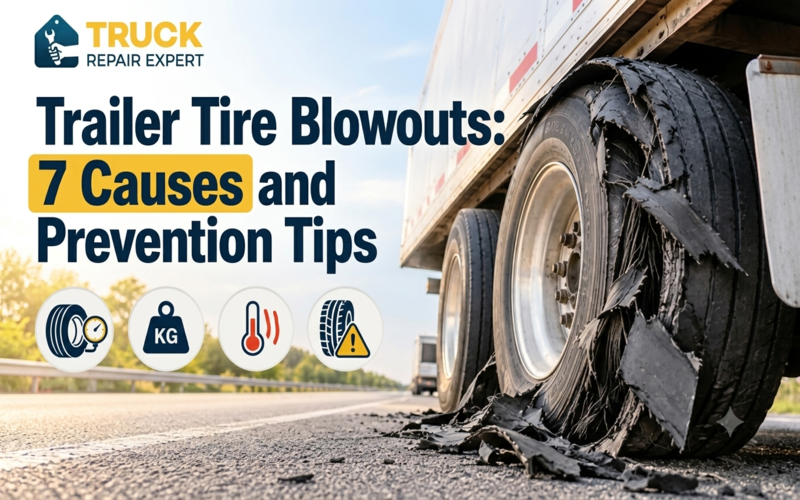
A trailer tire can look perfectly normal at the start of a trip and fail miles later with little apparent warning. For commercial drivers and fleet operators, that sudden bang is more than an inconvenience. A blowout can damage the trailer, interrupt a delivery, create an unsafe roadside stop, and turn a small tire problem into hours of downtime.
The important thing to understand is that many trailer tire blowouts are not truly sudden. The final failure may happen in seconds, but the conditions behind it—low pressure, excessive heat, overloading, tire damage, irregular wear, or aging—may have been developing for days or months.
Knowing what causes trailer tires to blow out makes those failures easier to prevent.
Why Do Trailer Tires Blow Out?
A tire is designed to support a specific load while operating within defined inflation, speed, and service conditions. Problems begin when the tire repeatedly operates outside those conditions.
Heat is particularly important.
As a tire rolls, its sidewall continuously flexes. When inflation pressure is too low or the tire carries excessive weight, that flexing increases. More flexing creates more heat inside the tire. If the tire cannot dissipate that heat effectively, its internal components can weaken.
Eventually, the tread, belts, casing, or sidewall may fail.
But underinflation is only one possible cause.
7 Common Causes of Trailer Tire Blowouts
1. Underinflation
Low tire pressure is one of the first things to investigate when trailer tires repeatedly fail.
When a tire does not contain enough air for the load it carries, the sidewalls flex excessively as the tire rotates. That movement generates heat and places additional stress on the casing.
A tire can therefore be damaged internally even when the tread still appears usable.
Pressure should be checked when the tire is cold and compared with the correct inflation requirement for the tire and load—not guessed from appearance.
A tire can look reasonably inflated and still be significantly low.
2. Overloading the Trailer
Every tire has a maximum load capacity.
If the trailer carries more weight than its tires are rated to support, those tires operate under excessive stress. The situation becomes even more dangerous when overloading is combined with low inflation or highway speeds.
The total trailer weight is not the only consideration.
Poor cargo distribution can place considerably more weight on one axle, side, or individual tire. That means a trailer may experience a tire problem even when the overall load does not immediately appear excessive.
Before hauling heavy freight, confirm the tire load ratings, axle ratings, and actual loaded weight.
3. Excessive Heat
Heat does not always originate in the tire itself.
A dragging trailer brake, wheel-end problem, bearing issue, or other mechanical fault can generate heat near the tire. Hot pavement, high ambient temperatures, heavy loads, sustained highway driving, and incorrect inflation can add even more thermal stress.
This is why an unusually hot tire or wheel position deserves attention.
If one tire repeatedly operates much hotter than the others, simply replacing the tire without identifying the underlying problem may result in another failure.
4. Tire Age and Weather Damage
Low mileage does not guarantee a healthy trailer tire.
Trailers may spend long periods parked outdoors, exposing tires to sunlight, ozone, temperature changes, moisture, and other environmental conditions. Rubber naturally changes as it ages, potentially becoming harder and developing cracks.
Look for:
- Sidewall cracking
- Weather checking
- Tread cracking
- Hard or brittle-looking rubber
- Bulges or deformation
The tire’s DOT date code can also help determine when it was manufactured.
Age should not be evaluated in isolation, however. Tire manufacturers may have their own inspection and replacement recommendations, and operating conditions matter greatly.
5. Road Hazards and Impact Damage
Potholes, curbs, road debris, nails, metal fragments, and sharp objects can damage trailer tires.
Some failures occur immediately. Others do not.
A severe impact can damage internal components without producing an obvious external failure at first. The weakened area may then fail later under load and highway heat.
After a significant curb strike, pothole impact, or suspected road-hazard event, inspect the tire carefully rather than assuming it is safe because it still holds air.
6. Incorrect Tire Selection
Not every tire is appropriate for every trailer.
Tire size, load capacity, construction, application, and speed capability must match the trailer and its operating conditions. Installing an underrated tire can leave little or no safety margin when the trailer is fully loaded.
Mixing incompatible tires can also create problems, particularly in dual assemblies where differences in inflation, diameter, or wear may cause one tire to carry more load than the other.
Correct tire selection is part of preventive maintenance—not simply a purchasing decision.
7. Alignment, Suspension, and Mechanical Problems
If one trailer tire repeatedly wears faster than the others, replacing the tire may treat the symptom rather than the cause.
Irregular wear can point toward:
- Alignment problems
- Worn suspension components
- Bent components
- Wheel-end problems
- Incorrect inflation
- Brake issues
- Mismatched dual tires
Patterns such as rapid shoulder wear, cupping, feathering, or one-sided wear should therefore be investigated rather than ignored.
Trailer Tire Blowout Causes at a Glance
| Problem | Warning Signs | What to Do |
| Underinflation | Low pressure, excessive flex, heat | Check cold pressure regularly |
| Overloading | Excessive tire stress, heat, deformation | Verify tire and axle load ratings |
| Aging | Cracks, weather checking, hardened rubber | Check age and condition |
| Road damage | Cuts, punctures, bulges | Inspect after impacts and road hazards |
| Alignment problems | Uneven or one-sided wear | Inspect alignment and suspension |
| Brake/wheel-end heat | One wheel position unusually hot | Diagnose brake and wheel-end components |
| Wrong tire specification | Poor load capacity or abnormal wear | Match tire to trailer application |
How to Prevent Trailer Tire Blowouts
There is no single maintenance step that prevents every failure. A reliable prevention strategy combines pressure management, visual inspection, load control, and early response to unusual wear.
Check Tires Before Every Trip
Walk around the trailer before departure.
Look at both visible and less-obvious areas of the tires for cuts, cracking, bulges, punctures, exposed material, unusual wear, and obvious pressure loss.
Do not forget the inside tire of a dual assembly simply because it is harder to see.
Measure Tire Pressure—Don’t Just Look at It
Visual checks are useful for obvious problems, but they cannot accurately determine inflation pressure.
Use an appropriate pressure gauge and check pressure when tires are cold. Fleet operators should establish consistent pressure-check procedures instead of waiting for a dashboard warning or visibly soft tire.
Monitor Tread Depth and Wear Patterns
Federal commercial-vehicle requirements establish minimum tread depths, but tread depth is only part of tire condition.
A tire may still have tread remaining while suffering from structural damage, separation, cuts, or other unsafe conditions.
Recording tread measurements over time also helps fleets identify abnormal wear before the tire reaches a critical point.
Respect Tire Load and Speed Limits
Do not assume a tire can safely handle any load simply because it fits the wheel.
Confirm the manufacturer’s load and speed ratings and make sure cargo is distributed correctly. High speed, heavy loading, hot weather, and underinflation can compound one another, creating conditions where heat builds rapidly.
Investigate Repeated Tire Failures
Two blowouts at the same wheel position should raise a bigger question:
Why is that position repeatedly failing?
The real problem may involve alignment, brakes, bearings, suspension, wheel condition, load distribution, or another mechanical issue.
Repeatedly installing replacement tires without diagnosing the cause can become expensive and dangerous.
Warning Signs You Should Never Ignore
Stop and investigate when you find a tire with a bulge, exposed cords or belt material, tread separation, significant cuts, an audible leak, unusual vibration, rapid pressure loss, or severe irregular wear.
Federal commercial tire regulations prohibit operation on tires with several serious conditions, including exposed ply or belt material, tread or sidewall separation, flats or audible leaks, and cuts that expose ply or belt material.
A tire problem discovered in the yard is much easier to manage than one discovered on the shoulder of an interstate.
What Should You Do If a Trailer Tire Blows Out?
If a blowout happens while driving, focus first on maintaining control and reaching a safe stopping location.
Avoid abrupt steering inputs. Reduce speed in a controlled manner and move away from active traffic when it is safe to do so.
Once stopped, do not assume the damaged tire is the only issue.
A blowout can damage the wheel, mudflap, air lines, brake components, wiring, suspension parts, or nearby tires. The adjacent tire in a dual assembly may also have temporarily carried additional load.
A proper inspection should therefore look beyond the shredded tire itself.
When Professional Trailer Tire Service Makes Sense
Some tire issues can be identified during a routine pre-trip inspection. Others require professional diagnosis, roadside replacement, or investigation into the mechanical reason behind repeated failures.
If a trailer tire is flat, damaged, leaking, badly worn, or has already blown out, Truck Repair Expert provides 24/7 mobile trailer tire repair and replacement for commercial operations. Mobile service can be particularly useful when moving the trailer would create additional risk or require towing.
The goal should not simply be to install another tire—it should be to return the trailer to safe operating condition and identify obvious contributing problems where possible.
Conclusion
Most trailer tire blowouts have contributing factors that exist before the moment of failure.
Underinflation, excessive load, heat, aging, road impacts, incorrect tire selection, and mechanical problems can all shorten tire life. More importantly, several of these conditions often occur together.
The best defense is a consistent routine: check pressure, inspect tire condition, measure tread, monitor loads, investigate abnormal wear, and respond quickly when something changes.
A few minutes spent inspecting trailer tires before departure can prevent a much longer—and more expensive—stop on the highway.
Frequently Asked Questions
What is the most common cause of trailer tire blowouts?
Underinflation is one of the most common contributors because insufficient pressure increases sidewall flex and heat buildup. Overloading, tire damage, aging, excessive heat, and mechanical problems can also cause failures.
Can a trailer tire blow out even if the tread looks good?
Yes. A tire can have adequate-looking tread while suffering from age-related deterioration, impact damage, separation, underinflation damage, or other internal problems.
How often should I check trailer tire pressure?
For commercial operations, tire condition should be part of the pre-trip inspection. Actual pressure should also be measured regularly with an appropriate gauge and whenever pressure loss or abnormal behavior is suspected.
What tread depth is required for commercial trailer tires?
Under federal commercial-vehicle regulations, tires other than those on the front wheels of a bus, truck, or truck tractor generally require at least 2/32 inch of tread depth in a major tread groove. Operators should verify current regulations applicable to their operation.
Why does the same trailer tire position keep blowing out?
Repeated failures at one position can indicate more than bad tires. Alignment, brakes, wheel-end components, suspension, load distribution, wheel condition, or dual-tire mismatch may be contributing.
Should a tire be replaced after hitting a large pothole?
Not automatically in every case, but it should be inspected carefully. A significant impact can cause internal or sidewall damage that may not be immediately visible.
Can a mobile tire service replace a blown trailer tire roadside?
Yes. When the location is safe and the problem can be serviced on-site, a commercial mobile tire technician can often inspect the failure and repair or replace the tire without towing the trailer.