
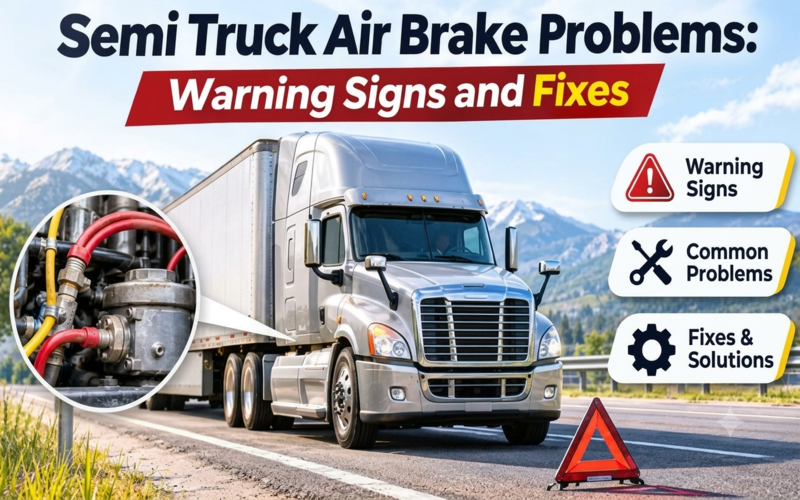
Air brakes are one of the most important systems on a semi truck, and one of the most common reasons trucks get placed out of service during inspections. A small leak or an out-of-adjustment brake might not feel like an emergency, but it can turn into one fast with a loaded trailer behind you.
The good news is that most air brake problems give warning signs first. Here’s what to watch for, what usually causes each problem and which repairs a mobile mechanic can handle where your truck is parked.
Common semi truck air brake problems include air leaks, slow pressure build-up, a pressure drop while parked, brakes that drag or pull, a low-air warning, moisture or oil in the air tanks, and brakes out of adjustment. Causes include damaged lines and fittings, failing brake chambers, worn slack adjusters, a weak compressor or a bad air dryer. Many of these can be repaired roadside, but low-air warnings and brakes that won’t hold mean the truck should stop until it’s fixed.
How Air Brakes Work (The Short Version)
An engine-driven compressor fills the air tanks. When you press the brake pedal, air flows to brake chambers at each wheel, which push a rod connected to a slack adjuster. That turns a cam that presses the brake shoes against the drum.
Spring brakes work the opposite way. Strong springs apply the brakes, and air pressure holds them off. That’s why losing air pressure eventually makes the spring brakes apply on their own.
Any weak point along that chain, from compressor to tanks to lines to chambers, can cause trouble.
8 Warning Signs of Air Brake Problems
1. Hissing Sound When Parked
A steady hiss with the engine off usually means an air leak. Common spots are fittings, gladhands, hoses, brake chambers and valves. Listen around each wheel and at the trailer connections.
2. Air Pressure Builds Slowly
If it takes much longer than normal to build air, the compressor may be weak, the air dryer may be restricted or there may be a large leak. Your CDL manual and the truck’s specs list acceptable build-up times. Check yours during your pre-trip.
3. Air Pressure Drops Too Fast
During the leak-down test, pressure should only drop a small amount per minute. A faster drop points to a leak somewhere in the system.
4. Low-Air Warning Light or Buzzer
This warning comes on when pressure falls below a safe level. If it activates while you’re driving, safely pull over as soon as possible. If pressure keeps falling, the spring brakes can apply on their own.
5. Brakes Drag or Feel Hot
If a wheel end smells hot or the truck feels like it’s holding back, a brake may not be releasing. Causes include a stuck valve, a failing spring brake chamber or a slack adjuster problem.
6. Truck Pulls to One Side When Braking
Uneven braking can mean one brake is out of adjustment, contaminated with oil or grease, or not getting enough air.
7. Water or Oil in the Air Tanks
When you drain the tanks, you should see little moisture. Lots of water means the air dryer isn’t doing its job. Oil can point to a worn compressor. Moisture in the system can also freeze during a cold snap.
8. Longer Stopping Distances or a Soft Pedal Feel
If it takes more distance to stop, your brakes may be out of adjustment, worn or not getting full pressure. Get it checked before your next load.
Common Causes and Where They’re Fixed
| Cause | What it does | Usually fixed on-site? |
|---|---|---|
| Leaking air line or fitting | Pressure loss, hissing | Yes |
| Leaking gladhand seal | Trailer air loss | Yes |
| Failing brake chamber or diaphragm | Leaks, weak braking, dragging | Yes |
| Slack adjuster out of adjustment or worn | Long stopping, pulling, inspection failure | Yes |
| Bad valve (relay, quick release, protection) | Dragging or slow release | Usually |
| Saturated air dryer cartridge | Water in tanks | Yes |
| Worn compressor | Slow build-up, oil in tanks | Sometimes |
| Worn shoes or drums | Poor braking | Sometimes; heavy wear may need a shop |
Why Brake Adjustment Matters
Out-of-adjustment brakes are one of the most common violations found during roadside inspections. Automatic slack adjusters are designed to keep brakes adjusted, but they can wear out or fail. If one keeps going out of adjustment, it usually means something else is wrong, like a worn component. Re-adjusting it by hand isn’t a long-term fix.
What to Do If Your Air Brakes Act Up on the Road
- Low-air warning? Pull over safely as soon as you can.
- Set the parking brake and turn on your hazards.
- Set out triangles behind the truck.
- Listen for leaks and note where the sound is coming from.
- Don’t keep driving with a brake you know isn’t working right.
- Call for roadside truck repair with your location and symptoms.
How to Prevent Air Brake Problems
- Do a full air brake check during every pre-trip, including build-up, leak-down and low-air warning tests.
- Drain air tanks regularly unless they drain automatically.
- Replace the air dryer cartridge on schedule.
- Check gladhand seals and lines for wear or chafing.
- Watch brake stroke and slack adjuster function at each PM.
- Get small leaks fixed before they grow.
Mobile Air Brake Repair Across DFW
Truck Repair Expert’s certified mobile mechanics repair air leaks, brake chambers, slack adjusters, valves and air dryers on-site, so you don’t need a tow. We cover semi trucks, trailers, box trucks and heavy-duty trucks with 24-hour mobile service and truck road service.
We serve Dallas, Plano, Garland, Irving, Richardson, Allen and Sachse. Call 469-617-2028 or request service.
Frequently Asked Questions
What causes air brakes to lose pressure?
Usually leaks in lines, fittings, gladhands, brake chambers or valves. A weak compressor can also cause slow pressure build-up.
Is it safe to drive with an air leak?
Not if pressure is dropping or the low-air warning is on. Stop safely and get it repaired.
Why do my semi truck brakes keep going out of adjustment?
Often a worn or failing slack adjuster or another brake component. Manual adjustment alone doesn’t fix the root cause.
Why is there water in my air tanks?
The air dryer may not be working, often because the cartridge needs replacing.
Can air brakes be repaired roadside?
Many can, including air leaks, brake chambers, slack adjusters, valves and air dryers.