
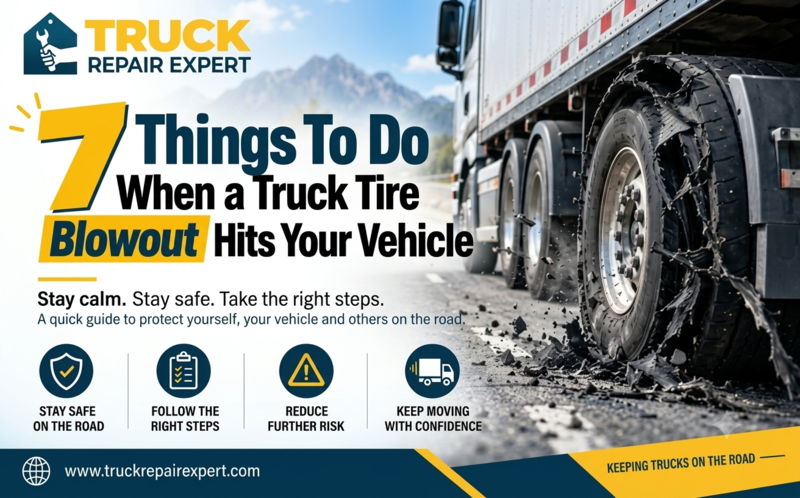
A truck tire blowout is different from a normal flat tire.
When a commercial truck tire suddenly fails, the driver may hear a loud bang, feel the vehicle pull or shake, or see pieces of tread in the mirrors. On a loaded semi, the situation can become dangerous within seconds.
So, what should you do when a truck tire blows out?
The priority is to stay calm, maintain control, slow down safely, and get away from moving traffic if possible. Do not immediately slam on the brakes or make a sudden steering correction. Once you’re in a safe location, assess the damage and arrange professional tire assistance if the tire cannot be safely replaced or repaired.
Here are seven practical steps to follow during a commercial truck tire blowout.
What Should You Do When a Truck Tire Blows Out?
If a truck tire blows out:
- Keep the steering wheel steady.
- Avoid sudden braking.
- Gradually reduce speed.
- Move to a safe location when possible.
- Turn on hazard lights and use warning devices as appropriate.
- Inspect the situation from a safe position.
- Call professional commercial tire assistance if the tire cannot be safely changed or repaired.
The exact response can depend on where the blowout occurs, traffic conditions, the road shoulder, weather, and the truck’s condition.
1. Keep the Truck Under Control
The first few seconds after a blowout can be the most stressful.
You may hear a loud explosion and immediately feel the truck move differently.
Your first goal is to maintain control.
Keep both hands on the steering wheel if possible and avoid making a sudden steering correction.
A blowout can change the truck’s handling, particularly when it occurs on a steer axle. The vehicle may pull or feel unstable.
Do not panic and try to force the truck back into its lane with an aggressive steering movement.
Make controlled adjustments.
2. Don’t Slam on the Brakes
One of the biggest mistakes after a tire blowout is reacting with sudden, hard braking.
A commercial truck is carrying significantly more weight than a passenger vehicle, and an abrupt braking maneuver can make an already unstable situation more difficult to control.
Instead, focus on keeping the vehicle stable and reducing speed gradually.
Once you’re moving slowly enough to safely leave the travel lane, look for the safest available location.
The goal is to reduce speed and regain a safe position, not stop instantly in the middle of traffic.
3. Move Away From Traffic
Once you have the truck under control, move toward a safe shoulder, emergency area, truck stop, rest area, or other location where the vehicle can be safely stopped.
If the truck cannot be moved safely, stay inside the cab when appropriate and follow your company’s emergency procedures.
A stopped commercial truck on the highway can create a dangerous roadside environment.
Use hazard lights and any required warning devices according to applicable safety procedures.
Do not stand unnecessarily close to moving traffic while inspecting the tire.
4. Determine Which Tire Failed
Once you’re in a safe location, try to determine what happened without putting yourself in danger.
A tire blowout may involve:
- Steer tire
- Drive tire
- Trailer tire
- Dual tire assembly
- Sidewall failure
- Tread separation
- Valve or inflation failure
Look for visible damage from a safe position.
You may see:
- Missing tread
- Torn sidewall
- Deflated tire
- Tire debris
- Damaged wheel
- Air leaking from another tire
- Damage to nearby components
Do not assume the tire is the only damaged part.
A serious semi truck tire blowout can damage mud flaps, fenders, brake components, wiring, wheel-end components, or nearby body parts.
5. Don’t Try to Repair a Dangerous Tire Yourself
A commercial truck tire is not the same as a passenger-car tire.
Truck tires operate under high inflation pressure and carry substantial loads. A damaged tire or wheel assembly can present serious hazards if handled incorrectly.
If the tire has completely failed, the safest approach is generally to have a qualified commercial tire technician inspect it.
Truck Repair Expert provides mobile commercial tire service for flat tires, blowouts, air leaks, punctures, tread damage, valve issues, and tire replacement.
A professional can determine whether the tire can be repaired or whether replacement is necessary.
6. Call for a Truck Tire Emergency Service
If the truck cannot continue safely, arrange professional roadside assistance.
When calling for a truck tire emergency, provide as much information as possible.
Tell the dispatcher:
| Information | Why It Matters |
| Exact location | Helps the technician find the truck |
| Truck type | Determines service requirements |
| Tire position | Steer, drive, or trailer |
| Tire size | Helps identify the replacement |
| What happened | Helps prepare for the failure |
| Vehicle condition | May indicate additional damage |
| Roadside conditions | Helps the technician prepare safely |
| Whether the truck is loaded | Provides important context |
If you know the tire size, provide it.
If you don’t, provide the truck’s year, make, model, axle position, and any information visible on the tire.
Truck Repair Expert’s commercial tire service includes mobile tire repair and replacement, with service for semi-trucks, box trucks, trailers, and other commercial vehicles.
7. Inspect the Other Tires Before Returning to the Road
Replacing the failed tire is important, but the remaining tires should not automatically be ignored.
A blowout can be a symptom of a broader tire problem.
Before continuing, the tire technician should consider issues such as:
- Low inflation
- Uneven tread wear
- Tire age and condition
- Sidewall damage
- Wheel damage
- Improper loading
- Alignment problems
- Valve or air-system problems
- Excessive heat
If one tire failed because of a condition affecting other tires, simply replacing the damaged tire may not solve the underlying problem.
Truck Repair Expert’s commercial tire service identifies underinflation, uneven wear, valve problems, punctures, tread damage, and other issues as common commercial tire concerns.
Why Do Commercial Truck Tire Blowouts Happen?
Understanding why blowouts happen can help reduce the chance of another failure.
Underinflation
A tire running below its recommended pressure can generate additional heat and wear.
Overloading
Excessive or improperly distributed weight increases stress on tires.
Tire damage
Punctures, cuts, sidewall damage, and tread problems can weaken a tire.
Uneven wear
Alignment, suspension, inflation, and loading issues can contribute to uneven tread wear.
Excessive heat
High temperatures combined with heavy loads, speed, and underinflation can increase tire stress.
Aging or worn tires
Tires deteriorate over time, even when they have not accumulated extremely high mileage.
Wheel or valve problems
A damaged wheel or leaking valve can result in gradual pressure loss and eventually contribute to a tire failure.
What Should You Do If a Steer Tire Blows Out?
A steer-tire blowout deserves particular attention because the front tires play a major role in steering.
The driver should concentrate on maintaining directional control and gradually reducing speed.
Avoid sudden braking or aggressive steering corrections.
Once the truck is safely stopped, do not continue driving on the damaged tire simply because the truck appears to move.
A professional inspection should determine whether the tire and wheel assembly can be safely returned to service.
What If a Trailer Tire Blows Out?
A trailer tire failure can still be dangerous, even if the driver does not immediately feel the same steering effect as a steer-tire failure.
Tire debris can damage the trailer, other tires, wiring, brakes, or nearby vehicles.
Once safely stopped, inspect the trailer from a safe position and arrange commercial tire service if necessary.
If the tire has damaged surrounding components, the technician should inspect those areas before the trailer returns to normal operation.
How Can You Prevent a Commercial Truck Tire Blowout?
No maintenance routine can eliminate every tire failure, but regular inspections can help identify problems before they become emergencies.
A practical tire-check routine includes:
- Check inflation regularly.
- Inspect sidewalls for damage.
- Look for uneven tread wear.
- Check tread condition.
- Inspect valves and valve stems.
- Watch for repeated air loss.
- Check wheels and wheel-end components.
- Monitor tire temperatures when appropriate.
- Follow the tire manufacturer’s recommendations.
- Avoid overloading the vehicle.
Drivers should also report unusual vibrations, pulling, noise, or changes in handling.
A small warning can sometimes appear long before a major tire failure.
What Are the Signs a Truck Tire May Fail?
A blowout doesn’t always happen without warning.
Possible warning signs include:
- Visible sidewall damage
- Bulges
- Cracks
- Uneven tread wear
- Repeated low pressure
- Excessive vibration
- Pulling
- Unusual tire noise
- Abnormally high tire temperature
- Missing tread
Some failures happen suddenly, but identifying developing tire problems during inspections can reduce the risk of unexpected roadside failures.
Truck Repair Expert’s existing tire guidance emphasizes that underinflation, uneven wear, damaged tires, and wheel-related problems should be addressed before they develop into more serious failures.
What If the Tire Blows Out at Night?
A nighttime truck tire emergency can be particularly challenging because visibility is lower and approaching traffic may be harder to see.
Once safely stopped:
- Turn on hazard lights.
- Use required warning devices.
- Stay away from traffic.
- Avoid standing behind the trailer unnecessarily.
- Use a flashlight if you need to identify the tire position.
- Contact professional roadside assistance.
Don’t attempt a complicated tire repair beside a high-speed roadway simply because it is dark and you need to get moving.
Safety should come before schedule.
What If You’re Carrying a Full Load?
A fully loaded commercial truck places substantial weight on its tires.
Tell the tire service provider whether the truck is loaded when you call.
This information can help the technician understand the roadside situation and prepare appropriately.
If the tire failure occurred because of a loading or weight-related issue, the remaining tires should also be inspected before continuing.
Frequently Asked Questions
What should you do when a truck tire blows out?
Keep the truck under control, avoid sudden braking, gradually reduce speed, move to a safe location, use appropriate warning devices, and call professional commercial tire assistance if the tire cannot be safely replaced.
What causes a commercial truck tire blowout?
Common causes include underinflation, overloading, tire damage, excessive wear, heat, uneven wear, valve problems, and wheel-related issues.
What should I do during a semi truck tire blowout?
Focus first on maintaining control and reducing speed gradually. Once safely stopped, avoid handling the damaged tire unnecessarily and arrange professional commercial tire service.
Can you drive a truck after a tire blowout?
You should not continue normal operation on a damaged tire. If the vehicle can be moved safely to a nearby secure location, do so cautiously; otherwise, arrange roadside assistance.
Can a blown commercial truck tire be repaired?
It depends on the type and extent of damage. A qualified technician should inspect the tire and determine whether repair is safe or whether replacement is required.
How can I prevent a truck tire blowout?
Regularly check tire pressure, inspect tread and sidewalls, address uneven wear, avoid overloading, monitor repeated air loss, and replace tires according to their condition and manufacturer recommendations.
Does mobile truck tire service handle blowouts?
Yes. Mobile commercial tire services can respond to roadside blowouts and provide tire inspection, repair, or replacement when appropriate. Truck Repair Expert currently offers 24/7 mobile commercial tire repair for blowouts and other tire failures.
Conclusion
Knowing what to do when a truck tire blows out can make a frightening roadside situation more manageable.
The first priority is always control. Keep the truck steady, avoid sudden braking, reduce speed gradually, and get away from moving traffic when it is safe to do so.
Once stopped, don’t treat the problem as simply replacing one tire. A commercial truck tire blowout can result from underinflation, damage, uneven wear, overloading, heat, or another underlying issue.
A professional inspection can determine whether the failed tire needs repair or replacement and whether the remaining tires and wheel-end components should also be checked.
For drivers dealing with a commercial truck tire blowout or another truck tire emergency, Truck Repair Expert provides mobile commercial tire repair and replacement for semi-trucks, trailers, box trucks, and other commercial vehicles.