
What Are the Signs Your Diesel Engine Needs a Mechanic?
Diesel engines are built to handle demanding work, but they still give warning signs when something isn’t operating correctly.
A strange noise, hard start, excessive smoke, loss of power, or rising engine temperature can indicate a problem that deserves attention.
For truck owners and drivers, recognizing these symptoms early can help prevent a relatively manageable repair from turning into a major engine or roadside failure.
Table of Contents
ToggleWhat Are the Signs Your Diesel Engine Needs a Mechanic?
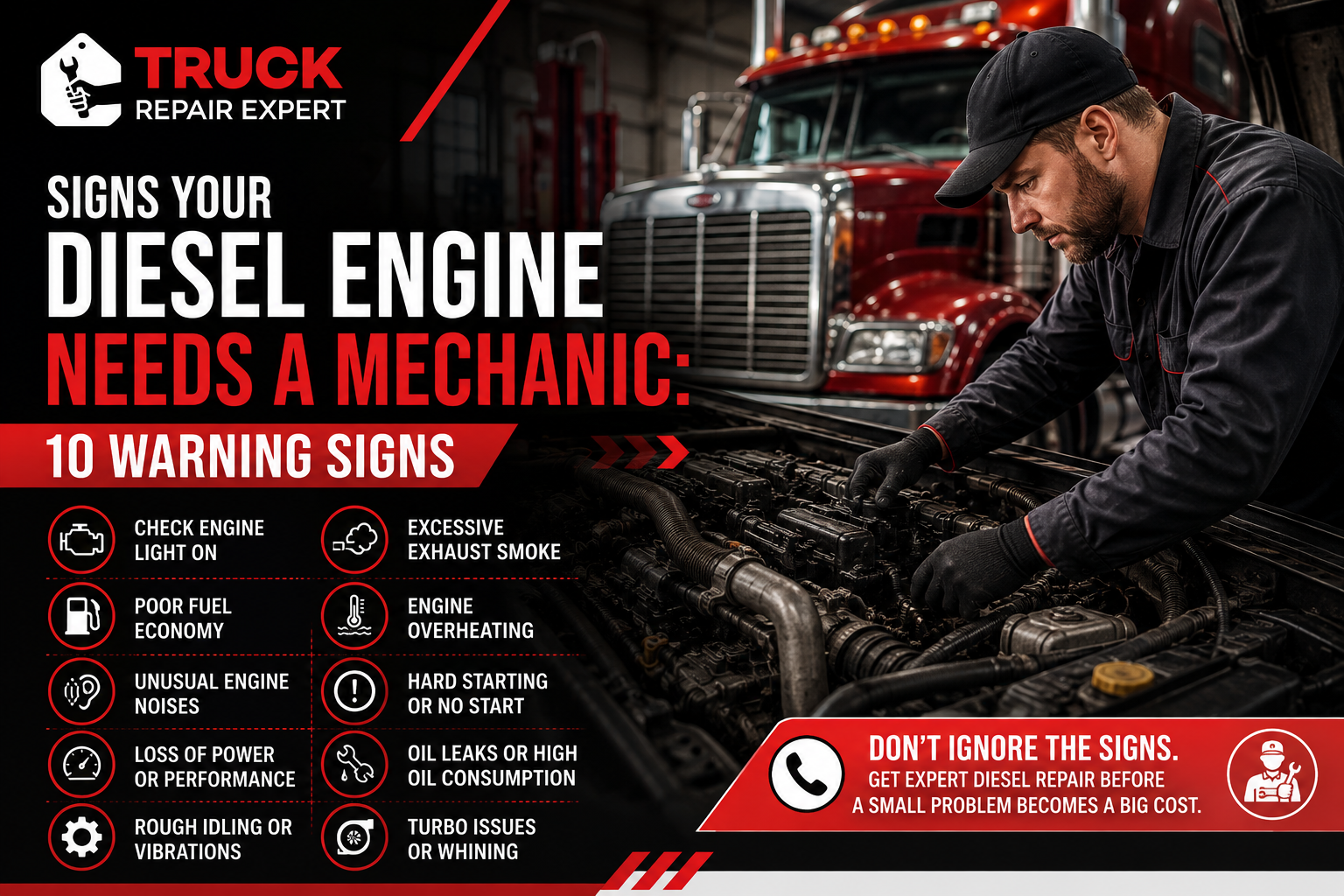
Common signs a diesel engine needs a mechanic include difficulty starting, unusual engine noises, excessive exhaust smoke, loss of power, overheating, rough idling, poor fuel economy, warning lights, fluid leaks, and excessive oil consumption. One symptom does not always identify the exact problem, so a professional diesel mechanic may need to inspect and diagnose the truck before recommending repairs.
The important thing is not to ignore a noticeable change in how the engine operates.
10 Signs Your Diesel Engine May Need a Mechanic
1. The Engine Is Difficult to Start
A healthy diesel engine should start consistently under normal operating conditions.
If the truck suddenly takes longer to start, requires repeated attempts, or struggles to start when it previously started normally, something may have changed.
Potential causes can include problems involving the battery, starter, fuel delivery, glow or intake heating systems where applicable, sensors, or other engine components.
Cold weather can also affect starting performance, so the circumstances matter.
If hard starting continues after the weather changes or occurs when the engine is warm, it is worth having the truck diagnosed.
2. The Engine Is Losing Power
Loss of engine power is one of the more noticeable diesel engine problems for drivers.
You may notice the truck:
- Struggles to accelerate
- Has difficulty climbing hills
- Feels weaker under load
- Takes longer to reach normal speed
- Performs differently than it normally does
The cause could range from fuel delivery or air-intake problems to turbocharger, sensor, exhaust, or engine-related issues.
Because multiple problems can produce similar symptoms, replacing parts based only on the symptom can be an expensive guessing game.
3. You See Excessive Exhaust Smoke
Some exhaust smoke can be normal depending on engine operation and conditions, but a sudden or persistent change deserves attention.
The color, amount, and circumstances can provide useful clues.
For example, unusual white, blue, or black smoke may point toward different types of problems involving fuel combustion, oil, coolant, or air supply.
Smoke by itself does not provide a definitive diagnosis.
A mechanic needs to consider the smoke alongside engine temperature, fluid levels, performance, fault codes, and other symptoms.
4. The Engine Is Overheating
An overheating engine should never be treated as something to simply monitor indefinitely.
If the temperature gauge rises beyond its normal operating range or the truck repeatedly overheats, there may be a problem with the cooling system or another engine component.
Possible causes can include:
- Coolant leaks
- Cooling-system problems
- Radiator issues
- Thermostat problems
- Water pump problems
- Cooling fan issues
- Other engine-related faults
Continuing to operate an overheating engine can increase the risk of serious damage.
If the temperature rises significantly, follow the manufacturer’s safety guidance and have the truck evaluated.
5. You Hear New or Unusual Engine Noises
Drivers often know what their truck normally sounds like.
That makes a new knocking, ticking, rattling, grinding, hissing, or whining sound worth paying attention to.
The location, timing, and operating conditions of the noise can help a mechanic narrow down the possible cause.
For example, a noise that only occurs during acceleration may point toward a different area than one that continues while the engine is idling.
Don’t assume that a new noise will disappear on its own.
6. The Engine Idles Roughly
A diesel engine that suddenly begins idling unevenly, shaking excessively, or running inconsistently may be experiencing an underlying issue.
Possible causes can involve fuel delivery, injectors, air intake, sensors, engine management, or other components.
A rough idle is particularly worth investigating when it appears together with hard starting, smoke, poor acceleration, or a warning light.
The combination of symptoms often gives a mechanic more useful information than any single symptom by itself.
7. Fuel Economy Gets Worse
A noticeable drop in fuel economy can sometimes indicate that the engine is no longer operating as efficiently as it should.
Before assuming the engine is at fault, consider other factors such as:
- Heavier loads
- Different routes
- More idling
- Weather
- Tire pressure
- Driving habits
- Fuel quality
If operating conditions haven’t changed but fuel consumption has noticeably increased, a diesel mechanic can check the truck for possible mechanical or engine-management issues.
8. The Check Engine or Warning Light Comes On
Dashboard warning lights should not automatically be ignored just because the truck continues running.
A warning light may indicate anything from a relatively minor issue to a problem requiring immediate attention.
A diagnostic scan can retrieve fault codes stored by the vehicle’s electronic systems.
However, a code isn’t necessarily a direct instruction to replace a specific component. Proper diagnosis requires interpreting the code and testing the system involved.
If a warning light is accompanied by severe symptoms such as major power loss, overheating, unusual smoke, or abnormal engine noise, the situation deserves more immediate attention.
9. You Notice Oil or Coolant Leaks
A puddle or visible fluid around the truck is a reason to investigate.
Oil and coolant leaks can originate from hoses, seals, gaskets, fittings, reservoirs, or other components.
The type and location of the fluid can help identify the source.
Ignoring a small leak can sometimes allow it to become a much larger problem. A low coolant level, for example, can contribute to overheating, while inadequate engine oil can create serious lubrication problems.
10. The Engine Is Using More Oil Than Usual
If you’re regularly adding engine oil between normal service intervals, don’t assume that the engine simply needs more oil.
Increased oil consumption can have several possible causes, including leaks or internal engine-related problems.
Track how much oil the truck is using and whether the consumption has changed.
That information can help a mechanic determine whether further inspection or testing is necessary.
When Should You Stop Driving a Diesel Truck?
Not every engine symptom means the truck must immediately be taken out of service, but some warning signs should be treated seriously.
Consider stopping and getting professional assistance when the truck has symptoms such as:
- Severe overheating
- Major loss of engine power
- Significant oil or coolant leakage
- Severe or rapidly worsening engine noise
- Heavy or unusual smoke
- Serious warning indicators
- A noticeable change that makes the vehicle unsafe to operate
The safest decision depends on the specific symptoms and the manufacturer’s guidance.
When in doubt, don’t continue driving simply because the truck can still move.
Why Early Diagnosis Matters
A diesel engine problem rarely becomes cheaper because it is ignored.
A driver might notice a small symptom and continue operating the truck because the vehicle still runs. But if the underlying issue worsens, the eventual repair may involve additional components and significantly more downtime.
Early diagnosis gives the mechanic an opportunity to identify the underlying cause and determine what needs attention.
For owner-operators, that can help protect income and prevent unexpected roadside downtime.
For fleet managers, identifying problems early can make maintenance easier to schedule and reduce disruptions to operations.
What Information Should You Give the Diesel Mechanic?
When bringing a truck in for diagnosis, don’t simply say, “The engine isn’t running right.”
Give the mechanic as much useful information as possible.
Tell them:
- When the problem started
- Whether it happens when the engine is cold or warm
- Whether it occurs under load
- What speed or RPM it happens at
- Whether a warning light appeared
- Whether fuel economy changed
- Whether smoke appeared
- Whether you hear a new noise
- Whether the truck recently received repairs
A detailed description can help the mechanic reproduce the problem and narrow down possible causes.
Frequently Asked Questions
Q. What is the most common sign of a diesel engine problem?
There isn’t one symptom that applies to every diesel engine problem. Hard starting, power loss, unusual smoke, overheating, warning lights, rough running, and abnormal noises are common warning signs that deserve investigation.
Q. Can a diesel engine problem be diagnosed from symptoms alone?
Symptoms can provide useful clues, but they usually aren’t enough to identify the exact failed component. A diesel mechanic may need to perform a visual inspection, diagnostic scan, measurements, or other tests before recommending a repair.
Q. Is black smoke always a sign of a diesel engine problem?
Not necessarily. Smoke can vary depending on engine operation and conditions. However, persistent or excessive black smoke, particularly when combined with poor performance or other symptoms, should be evaluated by a qualified mechanic.
Q. Should I drive a truck with the check engine light on?
It depends on the warning and how the truck is operating. A truck that has a warning light plus overheating, severe power loss, unusual engine noise, or other serious symptoms should be evaluated promptly rather than continuing to drive normally.
Why is my diesel truck losing power?
Loss of power can have several causes, including fuel delivery problems, air-intake restrictions, turbocharger issues, sensors, exhaust or emissions-system problems, and engine-related faults. Proper diagnostics are needed to identify the actual cause.
How do I know if a diesel engine is overheating?
A temperature gauge moving above its normal range, an overheating warning, coolant loss, unusual engine behavior, or other signs of excessive heat can indicate an overheating problem. If the engine temperature becomes dangerously high, follow the manufacturer’s instructions and seek professional assistance.
Can regular maintenance prevent diesel engine problems?
Regular maintenance cannot prevent every failure, but it can help identify wear, leaks, fluid problems, and other developing issues before they become more serious. Following the manufacturer’s maintenance recommendations is an important part of protecting engine reliability.
Final Takeaway
Diesel engines usually give drivers clues before a serious problem develops. Hard starting, power loss, unusual smoke, overheating, new engine noises, rough idling, worsening fuel economy, warning lights, fluid leaks, and increased oil consumption are all symptoms worth paying attention to.
The key is not to diagnose the problem by guessing which part needs replacement. Instead, document what you’re experiencing and have a qualified diesel mechanic inspect the truck when the symptoms persist or become serious.
Finding the cause early can help reduce downtime, avoid unnecessary repairs, and keep a working truck on the road more reliably.