
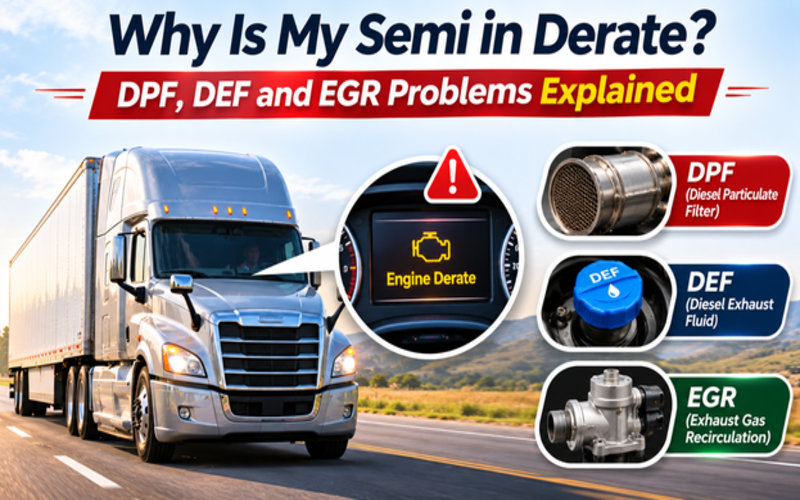
You’re running fine, then a light comes on and the truck won’t go past a certain speed. That’s a derate. It’s one of the most frustrating problems for drivers because it often shows up with little warning and can make you late for a load.
In most modern trucks, a derate is the engine computer protecting the engine or the emissions system. Something has gone wrong, and the truck limits power until it’s fixed.
Here’s what usually causes a derate, what the warning lights mean and what you can do about it.
A semi truck goes into derate mode when the ECM detects a problem that could damage the engine or break emissions rules. The most common causes are DEF problems (low level, bad fluid, a failed heater or pump), a clogged DPF or failed regeneration, faulty NOx or temperature sensors, and EGR valve or cooler problems. A diagnostic scan pinpoints the cause, and many sensor, wiring and DEF issues can be repaired on-site.
What Is a Derate?
A derate, sometimes called limp mode, limits engine power and road speed. It usually happens in stages:
- Warning lights come on, such as the check engine, DPF or DEF light.
- Reduced power if the problem isn’t fixed.
- Speed limits, which get stricter the longer the fault stays active.
The exact stages and timing depend on the engine make, model year and software. That’s why two trucks with the same fault can behave differently.
The Emissions Systems Behind Most Derates
Modern diesel trucks use several systems to clean up exhaust:
| System | What it does | Common problems |
|---|---|---|
| DPF (diesel particulate filter) | Traps soot | Clogs, failed regens, pressure sensor faults |
| DEF / SCR | Uses diesel exhaust fluid to reduce NOx | Low or bad DEF, failed pump or heater, crystallized doser |
| EGR (exhaust gas recirculation) | Sends some exhaust back into the engine to lower NOx | Stuck valve, clogged or leaking cooler |
| DOC (diesel oxidation catalyst) | Helps burn off pollutants and supports regens | Contamination, reduced efficiency |
| Sensors (NOx, temperature, pressure) | Monitor everything above | Sensor failure, wiring damage |
Common Causes of a Derate
DEF Problems
DEF is one of the most common derate triggers.
- Low DEF level. The simplest cause. Fill it up.
- Poor-quality or contaminated DEF. Use fresh, certified DEF from a sealed container or reputable pump.
- Failed DEF heater. DEF freezes at about 12°F, so heaters keep it usable in cold weather. A failed heater can trigger a fault during a cold snap.
- Failed DEF pump or doser. Crystals can build up and block the system.
DPF Problems
The DPF traps soot and burns it off through regeneration. Problems start when regens can’t finish.
- Excessive idling and short trips don’t create enough heat for passive regens.
- Ignored regen prompts let soot build up.
- A failing pressure sensor can report the DPF is full when it isn’t.
- Ash buildup over time means the DPF eventually needs professional cleaning.
EGR Problems
- Stuck EGR valve from soot buildup
- Leaking EGR cooler, which can sometimes show as coolant loss or white smoke
- Failed EGR sensors
Sensor and Wiring Faults
Not every derate means a big repair. A bad NOx sensor, a failed temperature sensor or a damaged wire can trigger the same derate as a major failure. That’s why a proper diagnosis matters before replacing expensive parts.
What to Do When Your Truck Goes Into Derate
- Don’t ignore the first warning light. The earlier you act, the less severe the derate.
- Check the DEF level and gauge.
- Note which lights are on and any messages on the dash.
- If prompted, complete a regen, either by driving at highway speed or doing a parked regen if your truck supports it and it’s safe.
- Pull the fault codes or call a mechanic who can.
- Stop safely if power drops enough to make highway driving dangerous.
What Can Be Fixed On-Site?
Many derate causes can be diagnosed and repaired by a mobile diesel mechanic:
- Reading and interpreting fault codes
- Replacing NOx, temperature and pressure sensors
- Repairing damaged wiring and connectors
- Fixing many DEF system issues
- Running a forced regen when appropriate
- Clearing codes after a repair
Some jobs, like DPF cleaning or major EGR cooler replacement, usually need a shop and special equipment.
A Word About Emissions Deletes
Some drivers consider removing or disabling emissions equipment to avoid derates. Tampering with emissions systems on road vehicles is illegal under federal law and can lead to large fines. It can also cause problems with resale, warranties and inspections. The better fix is proper diagnosis and repair.
How to Prevent Derates
- Use quality DEF and keep the tank topped off.
- Avoid long idling when possible.
- Let regens finish instead of interrupting them.
- Fix warning lights early.
- Follow your engine maker’s maintenance schedule for filters and sensors.
- Have the DPF cleaned at recommended intervals.
For more, see our guide to the most common semi truck breakdowns.
Derate Diagnosis and Repair Across DFW
Truck Repair Expert’s mobile diesel mechanics carry diagnostic tools for emissions systems on all major platforms, including International trucks. We provide semi truck repair, heavy-duty truck repair and 24-hour mobile service across Dallas, Plano, Irving, Garland and Richardson.
Call 469-617-2028 or request mobile service.
Frequently Asked Questions
Why is my semi truck in derate?
Most often because of a DEF, DPF, EGR or sensor problem that the ECM detects. A diagnostic scan finds the exact cause.
Can I keep driving in derate mode?
You can drive at reduced speed, but the derate may get more severe over time. Get it diagnosed as soon as possible.
Will refilling DEF fix a derate?
If the DEF was simply low, yes, often after the system confirms the new fluid. If the DEF is bad or a part has failed, more repair is needed.
What causes a DPF to clog?
Excessive idling, short trips, interrupted regens and normal ash buildup over time.
Can a mobile mechanic fix a derate?
Often, yes. Sensor, wiring, DEF and many regen-related issues can be repaired on-site.