
A trailer doesn’t get an engine’s attention, but it carries the freight, houses its own brake and electrical systems, and absorbs constant punishment from heavy loads and rough roads. When something goes wrong with a trailer, it’s rarely just an inconvenience, brake and lighting failures in particular are among the top reasons commercial vehicles get pulled out of service during roadside inspections.
Here are the five most common trailer problems drivers and fleets run into, the warning signs to watch for, and how to tell what needs attention right now versus what can be scheduled.
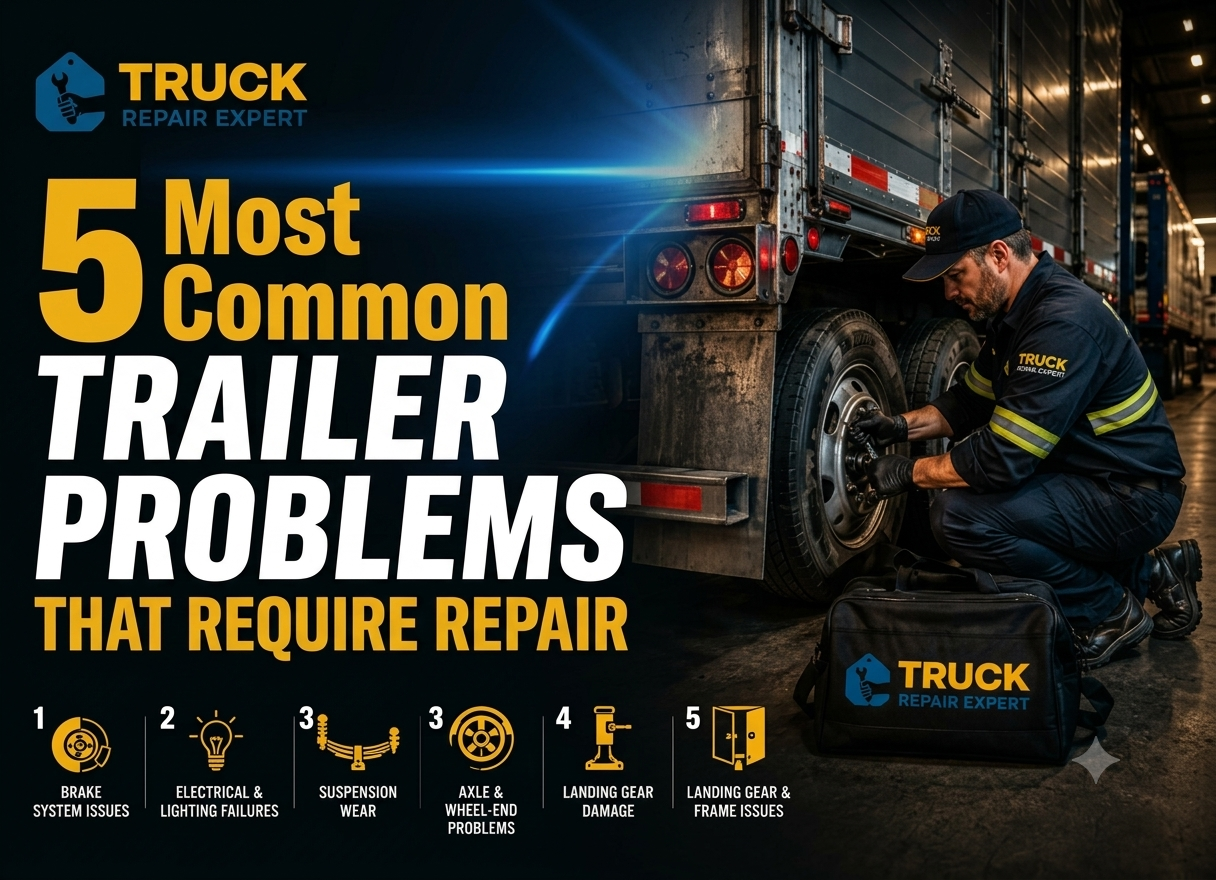
The five most common trailer problems that require repair are brake system failures, electrical and lighting issues, suspension wear, axle and wheel-bearing problems, and landing gear damage. Brake and lighting issues should always be treated as urgent, since they directly affect safety and DOT compliance — the others are usually safe to schedule but shouldn’t be ignored indefinitely.
1. Brake System Failures
Trailer brakes run on compressed air, and that system is the single most frequent source of trailer repair calls — and the leading cause of DOT roadside violations for trailers specifically.
Warning signs:
- A hissing sound near the wheels or air lines
- Slow air pressure buildup after connecting the trailer
- Reduced or uneven stopping power
- A brake warning light that won’t clear
Cracked air hoses, loose fittings, worn brake shoes, and slack adjusters that have drifted out of spec are the usual causes. Cold weather makes it worse, since trapped moisture in the air lines can freeze and block airflow entirely. This is one trailer problem that should never wait for a scheduled inspection to catch it.
2. Electrical and Lighting Issues
A trailer’s lights and ABS system rely entirely on a clean connection through the 7-way plug — a connection point that takes constant abuse from weather, road grime, and being plugged and unplugged daily.
Warning signs:
- Dim, flickering, or dead brake lights, turn signals, or marker lights
- A trailer ABS light that stays on or flashes
- Lights that cut out over bumps or in wet weather
Corrosion inside the plug or pigtail connector is one of the most common causes — in fact, when a trailer’s ABS light only comes on while it’s connected, the electrical connection is often the real source rather than the ABS module itself. Since working lights are both a safety and compliance requirement, this is worth checking before every trip.
3. Suspension Wear
A trailer’s suspension absorbs constant road shock under heavy weight, so it wears down gradually rather than failing all at once — which makes it easy to miss until it’s already a bigger problem.
Warning signs:
- Excessive bounce or sway, especially on turns
- The trailer sitting noticeably lower on one side
- Uneven tire wear that keeps returning even after new tires
Broken spring hangers, leaking shocks, and failing air suspension bags are the usual culprits, with air suspension failures especially common on newer trailers where the bags, lines, and height control valves are constantly exposed to vibration and weather. Left unaddressed, worn suspension accelerates tire wear and can eventually affect overall trailer stability.
4. Axle and Wheel-Bearing Problems
Axles and wheel ends carry the full weight of the load, making them a high-wear area — especially for trailers regularly hauling near maximum capacity.
Warning signs:
- Unusual noise from the wheel wells, especially at speed
- Rapid or uneven tire wear
- A trailer that feels unstable or pulls while towing
Axles can bend or misalign from sustained heavy loads or road impacts, leading to irregular tire wear and, if ignored long enough, added strain on the frame. Wheel bearing wear is a related but separate issue, usually noticed first as a growing noise rather than a change in handling.
5. Landing Gear Damage
Landing gear supports the trailer’s front end whenever it’s disconnected — easy to overlook, but a failure here can mean a trailer that won’t stand on its own, or worse, one that drops unexpectedly during hookup.
Warning signs:
- Difficulty cranking the landing gear up or down
- Visibly bent or uneven legs
- Heavy rust or corrosion on the mechanism
Parking on uneven ground and uneven load distribution both put uneven stress on one leg over time, which can cause bending. Corrosion is the other major factor, especially for trailers regularly exposed to moisture or road salt.
What’s Urgent vs. What Can Be Scheduled
Brake faults, ABS warning lights, and non-working lights should always be treated as urgent — they affect safety directly and can trigger a roadside out-of-service order. Suspension, axle, and landing gear issues are typically safe to schedule, but shouldn’t be pushed off indefinitely, since minor wear in these areas tends to escalate the longer it’s left unaddressed.
A Quick Pre-Trip Trailer Check
- Test every light — brake lights, turn signals, and markers
- Listen for air leaks at each brake chamber after connecting
- Crank the landing gear fully up and confirm it locks
- Look for broken springs, leaking air bags, or loose U-bolts
- Confirm the ABS light cycles off after startup
Where Truck Repair Expert Comes In
Our mobile diesel technicians diagnose and repair most common trailer problems on-site, wherever your trailer happens to be — brakes, electrical, suspension, axles, and landing gear included. Alongside trailer repair, we also service semi-trucks and tractor-trailers, box and delivery trucks, dump trucks and heavy equipment, fleet and commercial vehicles, diesel RVs and motorhomes, and provide 24/7 emergency roadside support for all of the above.
We’re available 24/7 across Dallas, Plano, Sachse, Garland, Irving, Richardson, Allen, Las Vegas, and Oakland, call 469-617-2028 any time your trailer needs attention.
FAQs: Common Trailer Problems
What’s the most common reason a trailer needs repair?
Brake system issues — particularly air leaks and worn components — are the most frequent cause, and account for the largest share of DOT roadside trailer violations.
Why does my trailer ABS light stay on?
Most often it’s a corroded or damaged 7-way plug or pigtail connection rather than an actual ABS module fault — worth checking the connector first.
Can trailer repairs be done roadside?
Many common issues — lighting, air leaks, brake adjustments, minor electrical faults — can be diagnosed and repaired on-site by a mobile technician without a shop visit.
How often should a trailer be inspected?
A quick pre-trip check of lights, brakes, and landing gear before every trip, plus a more thorough suspension and axle inspection on a regular maintenance schedule.
Is a swaying trailer dangerous to keep driving?
It can be. Excessive sway usually points to a suspension issue affecting load stability, and it’s worth having inspected before continuing a long haul.
The Bottom Line
Trailer problems tend to follow a predictable pattern — brakes, electrical, suspension, axles, and landing gear — and catching the early warning signs during routine checks is far cheaper than a roadside failure or an out-of-service citation.
If your trailer is showing any of these signs anywhere across Dallas-Fort Worth, Las Vegas, or Oakland, Truck Repair Expert’s mobile technicians can diagnose and repair it on-site — call 469-617-2028, available 24/7.